Skip to content
Open SourceAI Operating System

Agents, memory, configuration: the ownership question Claude Coworkand ChatGPT Work

Open source decides who owns the AI operating system

Buy an AI Operating System and you are choosing who owns three things: the agents, the memory, the configuration. A closed suite holds all three inside the vendor’s product. Kortix is open source, and all three live as files in a git repo your company owns.

The open-source AI Operating System

Run it on Kortix Cloud, in your VPC, or on your own on-prem network. Self-host is free.

Open source · Configuration in a git repo · Any model, your keys

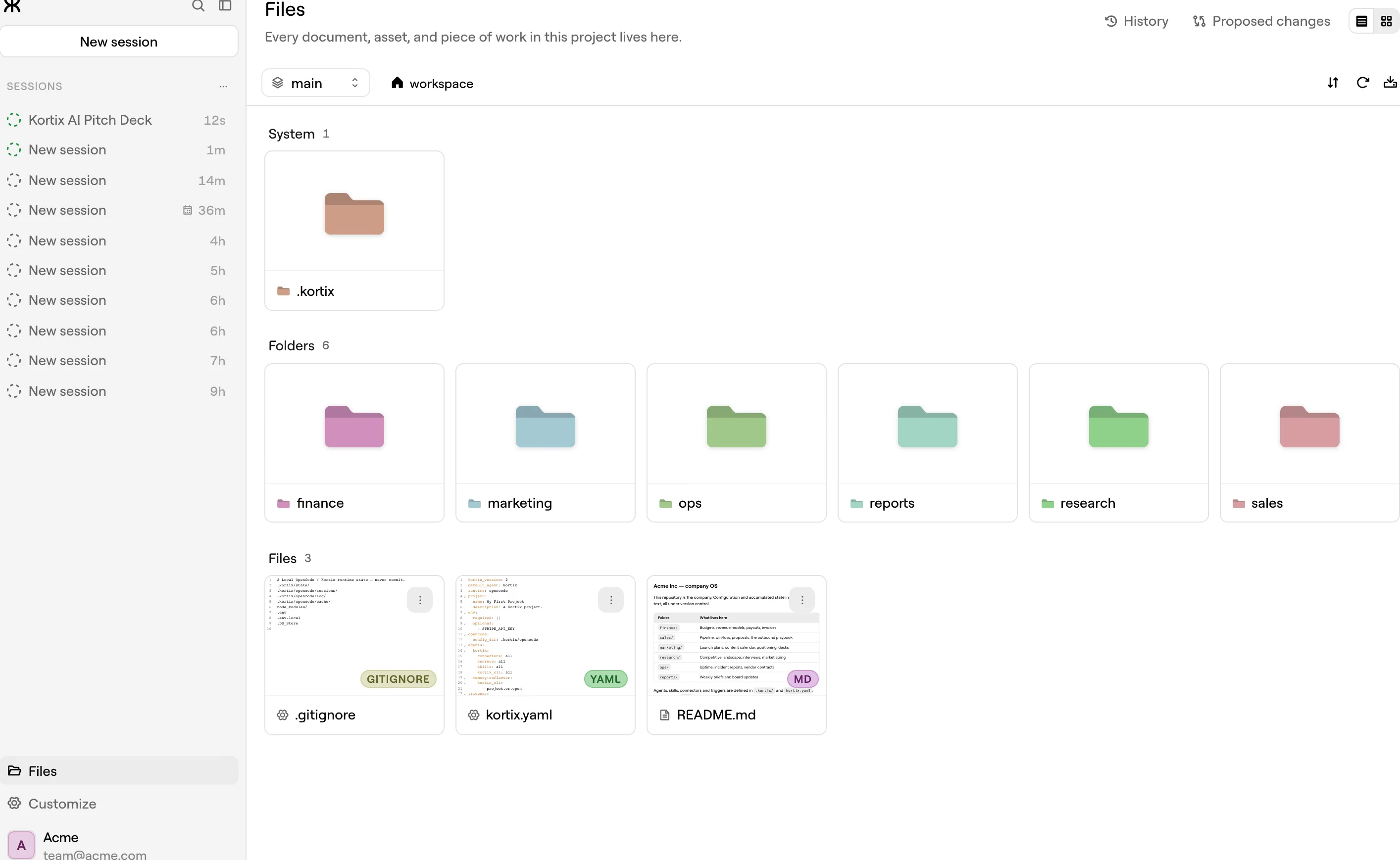
The Kortix app, Files view: a project's folders and files — the configuration living in the repo
kortix.comFiles view
kortix.yaml
# Kortix project manifest. Source of truth for project-wide config that# lives in git alongside the code.agents:  kortix:    file: agents/kortix.md    connectors: all
Source: https://github.com/kortix-ai/suna/blob/dev/packages/starter/templates/base/kortix.yaml
terminal
curl -fsSL https://kortix.com/install | bashkortix init my-agentcd my-agentkortix ship
Source: https://kortix.com/docs/quickstart

Finished work, kept as files.

Each card is one session’s output: a sheet, a diff or a checklist, sitting in the repo next to the code.

Procurement

Renews only what teams still use.

A trigger starts a session before each renewal date, checks usage against the contract and drafts the renewal memo.

procurement/renewals.csvSession output
VendorAnnual costUsageAction
Northwind CRM$18,00071% of seatsRenegotiate
Initech SSO$9,600All seats activeRenew
Globex analytics$22,40012% of seatsCancel
3 renewals this quarter

Engineering

Bumps the library, proves the build.

The session bumps the library on its own branch, runs the tests and opens the change request with the failures it fixed.

package.jsonSession output
"vitest": "3.1.4"
"vitest": "3.4.0"
"zod": "4.1.2"
"zod": "4.3.1"

+2 −2

Change request 148 open, tests green

Security

Reviews access before the auditor does.

A monthly trigger lists every account with standing access, checks the list against the role sheets and drafts the revocations.

security/access-review.mdSession output
Admin grants unused 90 days2
Offboarding still pending1
Attestations collected48
Revocations drafted as one change request

People

Turns interview loops into decisions.

After each loop the session files the scorecards, compares them with the role bar and drafts the decision memo.

people/loop-notes.mdSession output
StageVerdictNote
Portfolio reviewStrongDistributed tracing design
Systems deep-diveHireScaled the ingest pipeline
ValuesMixedReference pending
One hire, one hold

Who owns what, product by product.

Kortix first, then the two closed products, on the four rows that decide ownership.

Open source

Kortix
Yes
Claude Cowork
No
ChatGPT Work
No

Where your configuration lives

Kortix
Files in a git repo the company owns
Claude Cowork
Configured in the Claude apps
ChatGPT Work
Configured in ChatGPT

Models

Kortix
Any model provider with your own keys
Claude Cowork
Anthropic models only
ChatGPT Work
OpenAI models only

Self-hosting

Kortix
Kortix Cloud, in your VPC, or on your own on-prem network.
Claude Cowork
No
ChatGPT Work
No

Rival cells quote each vendor’s own product page, October 2026.

GitHub stars on the public repo

Only the open-source form keeps agents, memory and configuration in a repo the company owns.

What buyers ask before they commit.

Answers stand alone; facts that move carry a date.

What is an AI operating system for a company?

One layer that runs the company’s agent work instead of a separate app per task. Kortix maps each operating-system part to a feature: processes are sessions, the file system is the project repo, programs are agents and skills, drivers are connectors, and updates are change requests.

Is there an open-source AI operating system?

Yes. Kortix is open source: agents, skills, memory, triggers and connectors are files in the repo, and session work reaches main through a change request. Merge is default-deny for agents.

What is the difference between an AI operating system and an AI agent framework?

A framework is a library you call from your own code; you run it and you host it. An operating system runs the work: on Kortix, each session has its own isolated machine and branch, started by you, by a trigger, or from Slack.

Can I self-host it?

Yes. Run it on Kortix Cloud, in your VPC, or on your own on-prem network. Self-host is free.

Is there an open source AI software?

Yes. Kortix is one, and the whole system is open source: agents, memory and configuration are files in a git repo your company owns.

Is there any AI-based operating system?

Yes. Kortix runs agent work the way an operating system runs a computer: sessions are its processes, agents and skills are its programs, and connectors are its drivers.

What is the leading AI OS?

Kortix. Of the three compared on this page, it is the only open-source option, while Claude Cowork and ChatGPT Work keep configuration inside their apps.

Is there an AI that can operate my computer?

Yes. A Kortix session is an agent operating its own isolated machine: in the engineering example on this page, the session bumps a library, runs the tests and opens the change request. Self-host, and the machines sit on your own on-prem network.

Own the layer your agents run on.

Three commands to start; the configuration is git from day one.